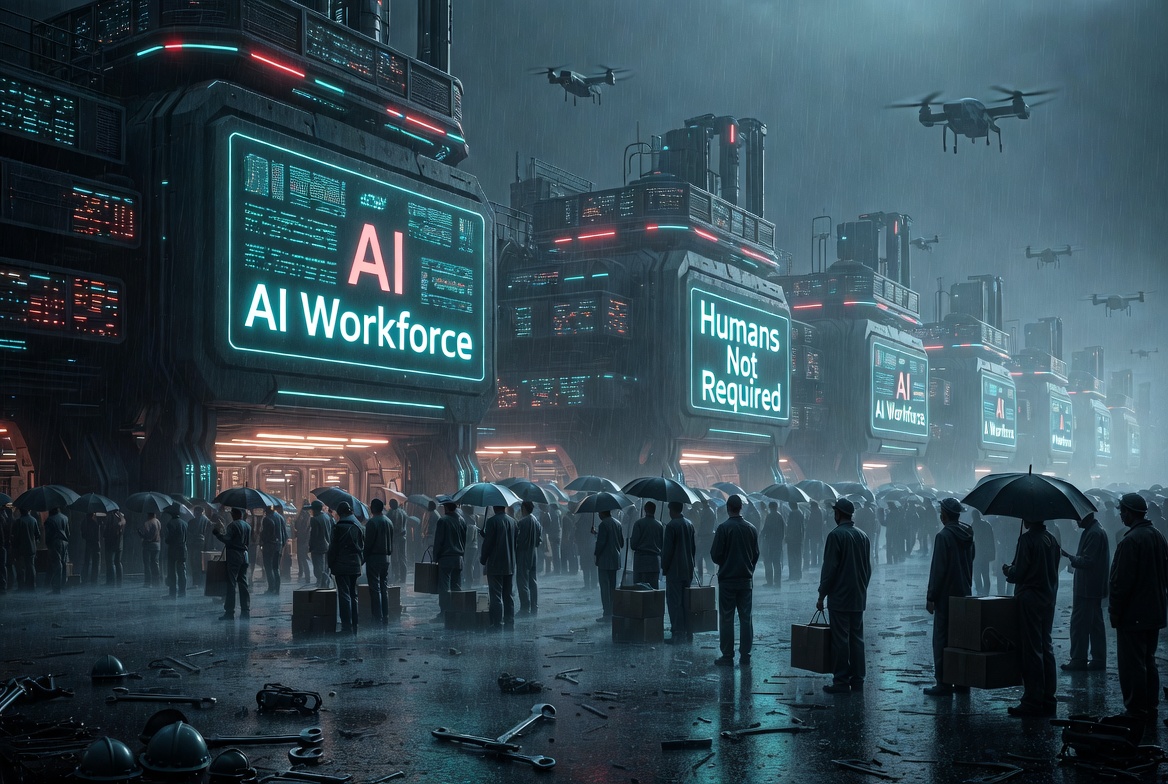
I love it when I’m wrong on the big existential crises. It hasn’t happened often, but it may have just happened on the biggest; the one which precipitated all of our efforts. (It in no way eliminates the value of A Celebration Society. If true–and it remains an if–we will still need a system of governance and for the provision of resources, opportunities and freedom.)
Patrick Herda, my friend and ally of 26 years, and the forthcoming CEO of what I believe will be one of the biggest and most impactful tech startups of the late 2020s, just reminded me that, in certain fields of activity, we humans will want human connection for at least another generation. These fields include those which impact our lives in permanent ways, including legal matters, finances and (most of all) health care.
That last one is greatly underserved. AIs will soon do most of the medical diagnoses as well as or better than human doctors. They will perform tests, and they will help with surgeries and, by the 2030s, perform most routine surgeries better than human surgeons.
None of that replaces people. I’m probably one of the most well-positioned people on the planet to welcome AI and robotic provision of my health care and, guess what? I will still want human doctors whom I trust to explain my diagnoses, and to supervise the machines doing my (hopefully few) surgeries. I will still want human nurses and health aides to hold my hand, to guide me through these most stressful situations.
So, too, does practically everyone else on the planet. Right now, medical services are already woefully underprovisioned. Even in so-called first-world countries, there is a crying shortage of services, especially specialists. Doctors and nurses are leaving some fields faster than new ones can be trained and recruited, because they are sick and tired of the corporatization of care, in which they must perform as units for revenue production rather than as caregivers. (There are notable exceptions, including Kaiser Permanante and Mayo Clinic, among other world-class nonprofits.)
Am I opposed to the profit motive? Not at all, provided it is balanced by service to a larger set of societal values. Unfortunately, in almost all nations today, there is no such cohesive set of values shared by all residents. In ACS, allegiance to those values (AKA The Charter) will be a requirement for all permanent residents in a given society, even as certain specific values may differ from one to another. The profit motive makes capitalism work, and we will need capitalism until we evolve beyond it.
Patrick argues, and I tentatively agree, that as whole professions fall like dominos to technological unemployment in the late 2020s and 2030s, there will be a kind of flywheel to take their place. Let’s get specific.
Very soon, professional drivers of all sorts will cease being economically useful. FSD (full self-driving) vehicles will not need human drivers. Loading and unloading of cargoes will be done, again more economically, by a robot or two that accompanies the vehicle. This represents millions of jobs in the US alone. Tens of millions worldwide. What will those people do?
While they could receive a universal basic income (UBI) and then decide to do whatever they please, I expect that most who, like nearly all of us, derive their sense of meaning from their work, which includes a sense of belonging to a community, will wish to do something useful.
All of these displaced people, and yes I do mean all of them, could be retrained as health care workers. While most wouldn’t go through the rigors of medical or nursing school, they could be well-employed and be much appreciated as nurses’ aides, intake workers for clinics and hospitals, and home health care providers. (Note: the latter would definitely include robots to do both the messy and the difficult work often associated with invalids.)
In the kind of massive increase in societal wealth which will soon be precipitated by effectively unlimited energy, AI, and raw materials (as documented in the book), antiquated notions such as “a mature economy can only grow by about 3% per year” will fall by the wayside. (Aside: I corresponded with Milton Friedman. When I asked him about that 3% figure, he replied that it had never made sense to him. He thought any economy could grow much faster, with the limits on freedom removed. He also thought that a world without effective limits on energy, AI, and raw materials would be “like Athens of the Golden Age, without the slaves.”)
Further, our present notions of healthcare are very limited. The blossoming field of regenerative medicine will soon make the decay process known as aging a thing of the past, with very long lifespans in healthy bodies at a functional age circa 30 the norm. Reversal of aging will follow. Achieving this will be a generational project.
In such a context, it is certainly plausible that all manner of human healthcare workers will be not only employable but prized, with incomes far in excess of today’s standards. (Yes, the trend has recently been downwards. Trends are byproducts of fundamentals.)
All that said, none of this would be easy. The societal disruptions to come will be seismic. There is a significant time lag between losing a job and being retrained as a health care worker. Not all will be willing to make that transition.
In addition to the health care option, there will soon be something else. We will in coming months be launching our social movement; the “bridge” between today’s world and the one to come. It will include amongst its free features a system to automate the launching of software apps. A person will need only an idea. (For B2B and non-software innovations, the company Patrick and I are helping to launch will have a well-capitalized incubator.)
I am not persuaded of the reality of this scenario as yet. I am still marinating on it. But I fervently hope to have been wrong about the prospect of long-term mass unemployment, at least for those who prefer jobs to having service projects. If you have thoughts on this, they are welcome.
Addendum: Patrick and I discussed this further. He is convinced that, as many others have argued, many kinds of new jobs will also spring up from this wave of automation, yielding a vast number of new jobs for humans. In this, we completely disagree. As I argued–I believe dispositively–in the book, the current wave of automation is fundamentally different than previous ones in that the machines can now do all of the types of thinking we humans can do; perhaps not as well in all cases, but well enough for most purposes. And that capability is accelerating.
AI experts whom I respect argue that human knowledge work is proving easy to automate. The work which is hard to automate includes skilled trades, such as tile work and other artisans. Even here, though, there is no assurance that, with ever-improving fine motor skills amongst robots, automation is not coming in the decades ahead.
Suppose Patrick and others are right about such new kinds of jobs spring up, which certainly cannot be ruled out. Nevertheless, as machine capabilities continue to rise, they will then also displace humans from those new jobs. Employers care not whether humans or machines perform tasks. Employers focus on cost/benefit analysis of the provision of those tasks. Cost/benefit will always favor the machines over time, even though in a few notable cases employers have been overzealous in firing people, later having to rehire them. I am confident that those rehirings will prove temporary.
Proponents of the new jobs argument love to cite farming as an example. Farming went from the majority of human jobs to almost none thanks to a previous wave of automation. The present wave will eliminate almost all of the remaining farming jobs. I do not see it creating new ones. (There may, for a generation or so, be more jobs for people who design and run cultured vat production of foodstuffs. But that, too, will be automated over time.)
Finally, some argue that human creativity will remain our unique province. But, again as argued in the book, even a decade ago creativity in all economically meaningful domains was already becoming a capability of AIs. Patents, which are the essence of novelty, have been invented by AIs. AIs write music in the style of old masters, indistinguishable from human creations, at least to most human ears. AIs have created fine art which has won competitions. AIs design new scientific experiments. AIs can code software projects, create legal arguments (with the need to watch for hallucinations), and so forth. I see no domain of human intellectual endeavor that is immune, over time.
All investment offerings are required to declaim, Past performance is no guarantee of future results. I believe that applies to automation as well.
Perhaps our uniqueness as a species (at least, a terrestrial species) will remain from two attributes. First, we can experience. While AIs can provide a very good simulation of experience, there is no evidence that they have an interior world like we do. Second, we may have certain psychic abilities. (I personally have had multiple such incidents, later empirically confirmed to my satisfaction. Many others have as well. Skeptics rightfully point out that such do not constitute scientific studies, and are subject to errors of judgment, or memory, or even of malice. There have been an admittedly limited set of such scientific studies at the University of Virginia, at Princeton, and I believe at Arizona State University. Much more research is needed, and some of us have conceived how ACS can provide a good proving ground for such studies. That is material for another blog.